Goldilocks CRM
- Goldilocks CRM: Overview and Account Setup
- Goldilocks CRM Dashboard
- Goldilocks CRM Contacts
- Goldilocks CRM Deals
- Goldilocks CRM: Sales Pipeline
- Goldilocks CRM: Tasks
- Goldilocks CRM: Activities
- User Profile & Settings
- Feedback and help
Goldilocks CRM: Overview and Account Setup
Goldilocks CRM: Introduction
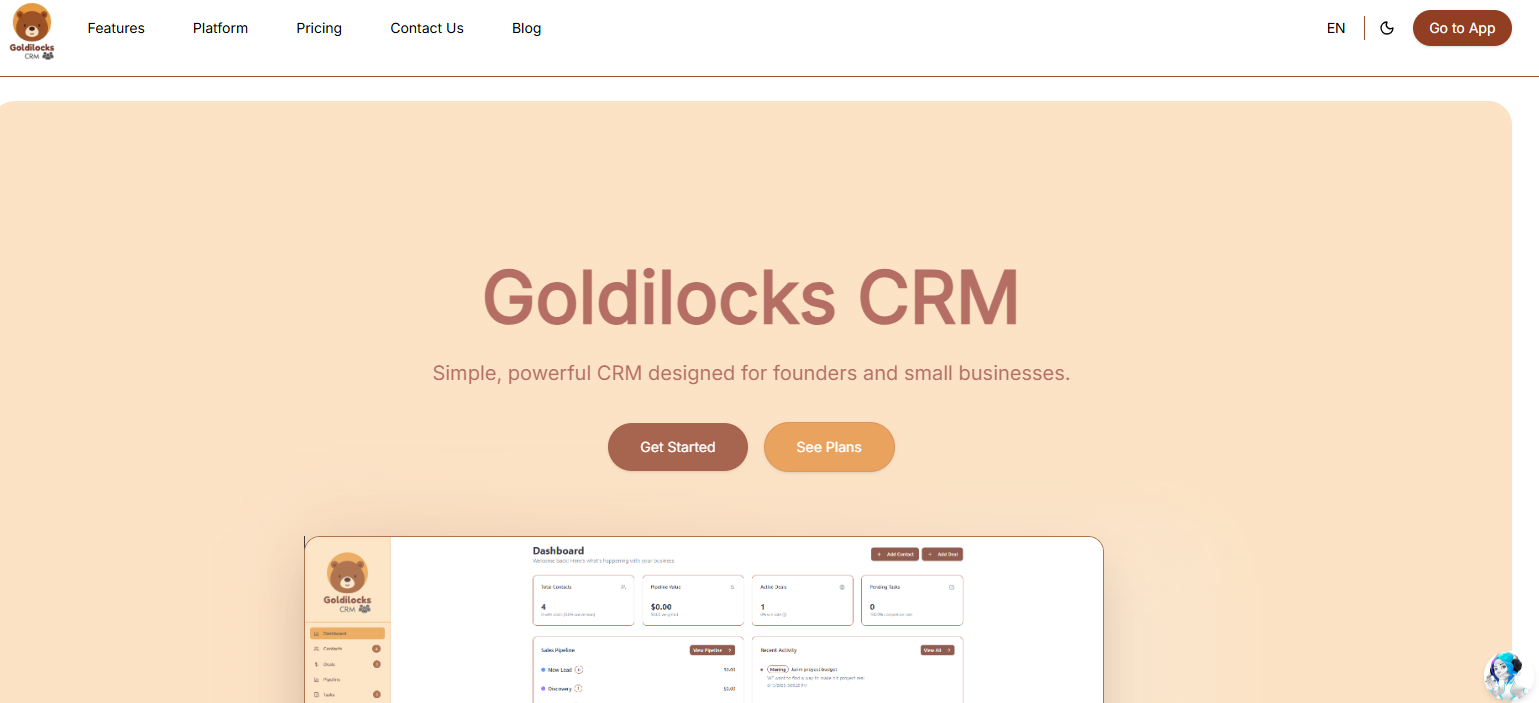
Goldilocks CRM is the customer relationship and sales management module within the BuildRunKit ecosystem. Designed specifically for founders and small businesses, it provides a simple yet powerful interface to track leads, manage deals, and organize your sales pipeline without the clutter of enterprise-level software.
Getting Started
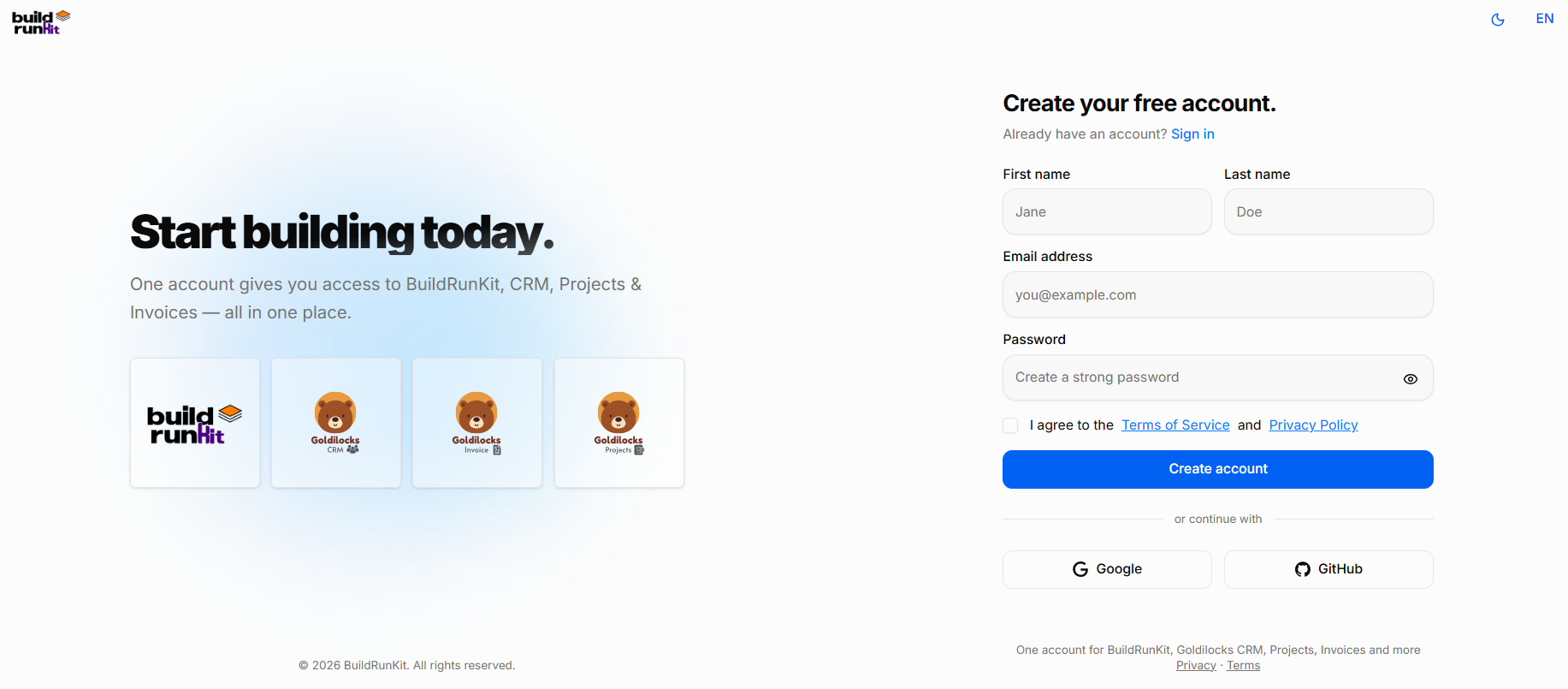
BuildRunKit is a unified workspace designed to help you plan, build, and run your business. One account gives you full access to the core platform plus the Goldilocks Suite (CRM, Invoices, and Projects).
Exploring the Platform Before signing in, you can use the landing page to explore the resources available to your business:
Accessing Your Account
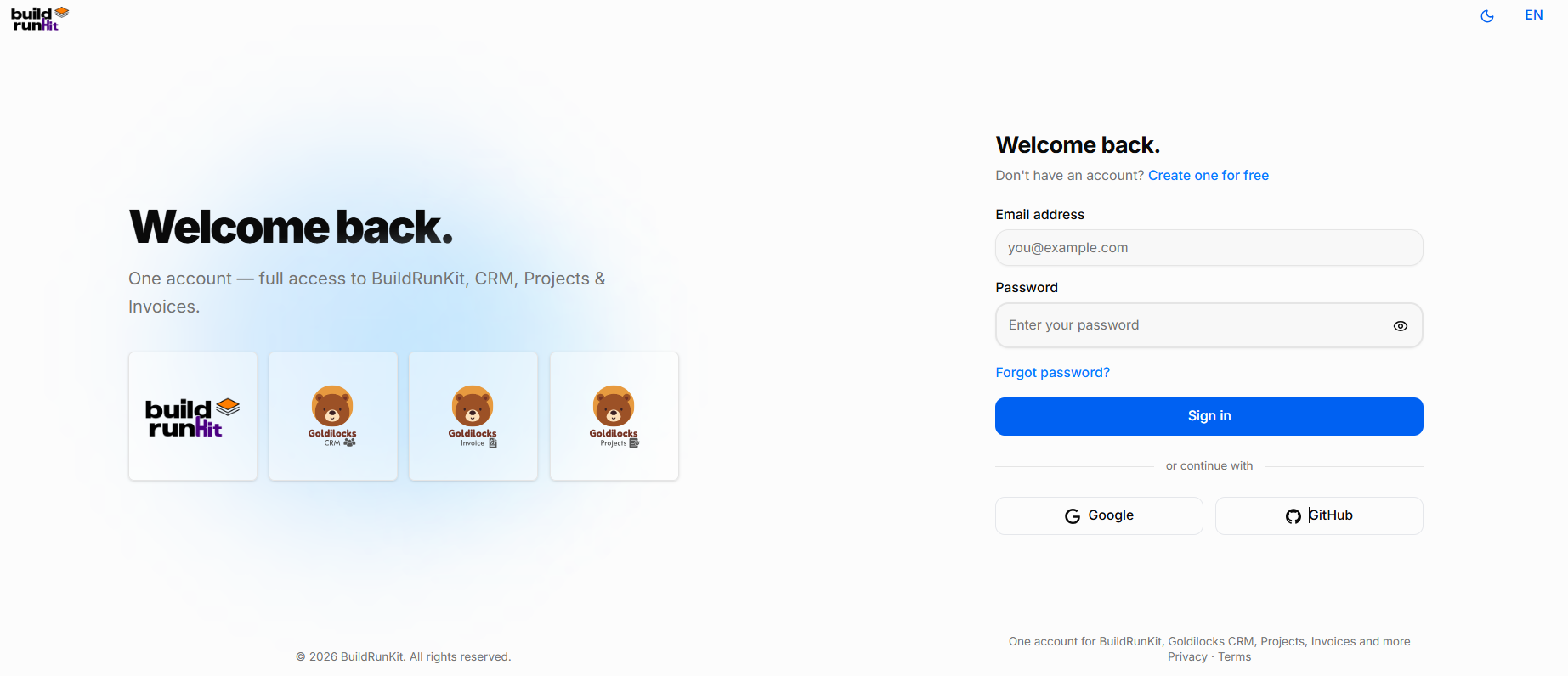
Once you have created your account, you can enter your workspace directly from the main landing page.
Entry Points
-
Go to App: Click the brown button at the top right of the screen to launch the CRM application.
-
Language Selection: Use the EN dropdown to choose your preferred interface language.
-
Theme Toggle: Click the Moon Icon next to the language settings to switch between Light and Dark modes.
Alternative Login Options
If you registered using a third-party account, you can log in instantly by clicking:
-
Google
-
GitHub
Note: If you are on this page by mistake and need to register, click the "Create one for free" link at the top right of the login box.
Goldilocks CRM Dashboard
Goldilocks CRM Dashboard
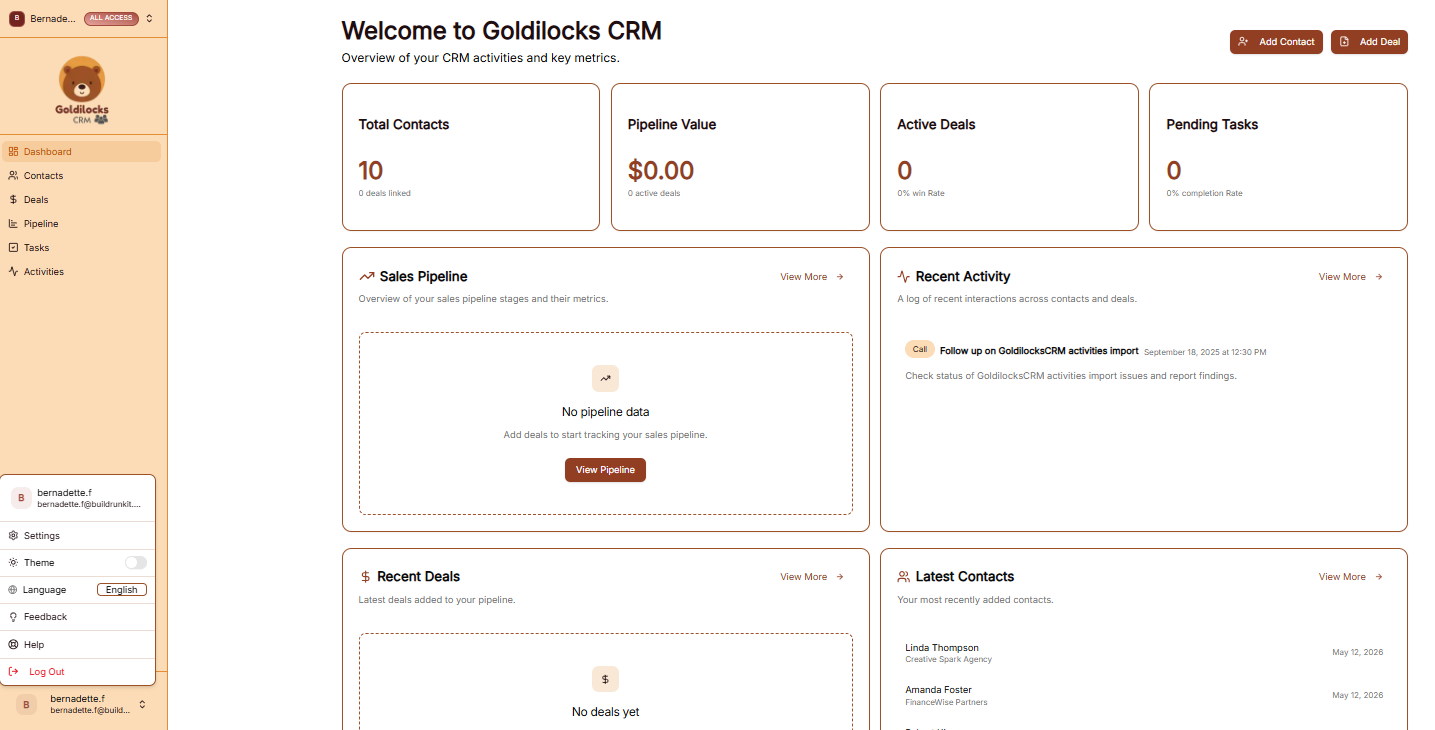
Once you have successfully signed in, you will be greeted by the Dashboard. This page is designed to give you an "at a glance" view of your latest sales activity, offer advanced filtering for your records, and provide fast jumps into your most important CRM workflows.
Managing Your Workspace
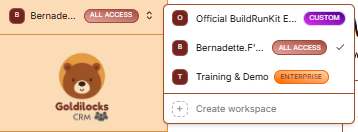
At the very top of the left sidebar, you will see your current workspace name. The platform allows you to manage multiple business environments from a single account.
How to Switch Workspaces:
-
Click the Workspace Selector: Click on the workspace name at the top of the sidebar.
-
Select from the List: A dropdown menu will appear showing all workspaces you have access to, such as "Official BuildRunKit Employee Workspace" or "Training & Demo".
-
Instant Switch: Click on the desired name to instantly switch all data (Contacts, Deals, and Tasks) to that workspace.
-
Create New: Click + Create workspace at the bottom of this menu to start a brand new business environment.
Activity Overview Cards
The top cards provide a quick count of your latest synced data and performance metrics:
-
Total Contacts: Total count of people and clients in your database.
-
Pipeline Value: The total financial value of all your active deals.
-
Active Deals: The number of current sales opportunities and your win rate.
-
Pending Tasks: The count of upcoming work items and your completion rate.
Advanced Filtering
-
"Owner" Filter: Available on both the Customers and Deals views, this feature allows you to instantly filter large data sheets to isolate and display only the registries explicitly assigned to a specific team member.
Quick Action Sections
-
Sales Pipeline: View your progress through various sales stages. Click View Pipeline to manage your active deals.
-
Recent Activity: A live log of your latest interactions, including calls and system updates with specific timestamps.
-
Recent Deals: View newly created opportunities. If empty, click Add Deal at the top right to start.
-
Latest Contacts: See a list of newly added contacts, their company names, and their creation dates.
Dashboard Entity Deletion
You can manage and prune a contact's related records cleanly from their main overview board without opening separate global lists:
-
Direct Removal: Delete associated Deals, Tasks, and Activities right from the individual contact dashboard view.
-
Streamlined Workflow: This update eliminates the hassle of navigating through massive registry lists to remove obsolete or outdated relations.
Navigation Sidebar
-
Dashboard: Returns you to this overview page.
-
Contacts: Access your full client and lead directory.
-
Deals: Manage your sales opportunities and revenue.
-
Pipeline: View and customize your sales workflow stages.
-
Tasks: View and manage your assigned action items.
-
Activities: Review the full history of interactions across your workspace.
Goldilocks CRM Contacts
Goldilocks CRM Contacts Dashboard
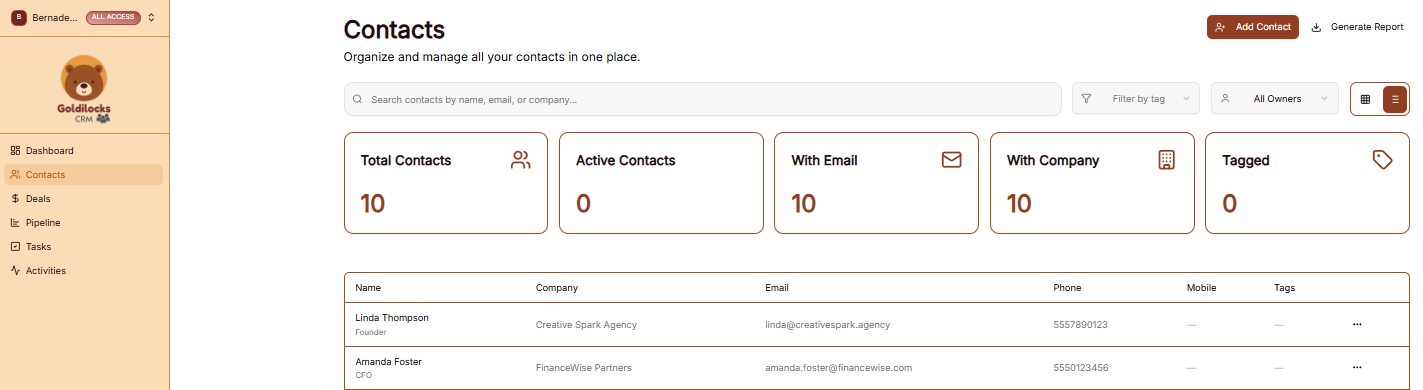
The Contacts page is your central directory for organizing and managing all individual relationships within your workspace. This page provides a high-level summary of your database through five metric cards:
-
Total Contacts: Displays the absolute number of people in your CRM (e.g., 10).
-
Active Contacts: Tracks the number of individuals currently engaged in active deals.
-
With Email: Shows how many records include a primary email address.
-
With Company: Displays the number of contacts associated with a specific business.
-
Tagged: Indicates how many contacts have been categorized using custom tags.
How to Add a Contact
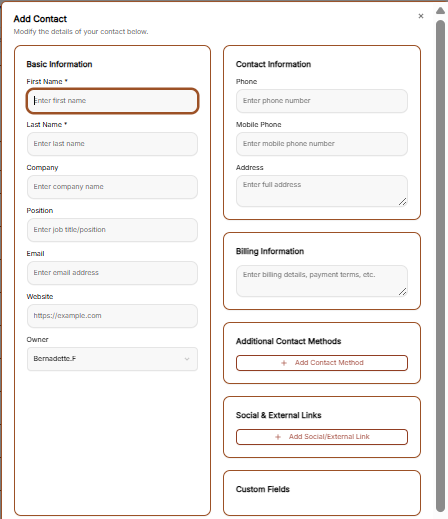
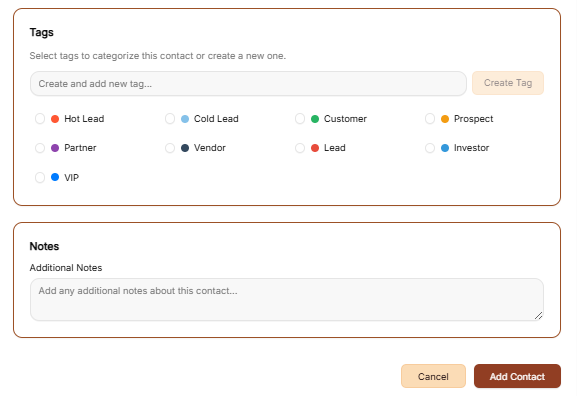
To manually enter a new individual into the system, click the brown + Add Contact button at the top right of the screen. This opens a detailed form where you can provide the following information:
-
Basic Information: Enter the contact’s First Name, Last Name, Company, Position, Email, and Website.
-
Contact & Billing: Store professional details like Phone and Mobile numbers, physical Addresses, and specific Billing Information for payments.
-
Social & Custom Data: Add Social & External Links or populate specialized data in the Custom Fields section.
-
Tags: Categorize the contact by selecting from preset options like Hot Lead, Customer, VIP, or Partner, or create your own unique tag.
-
Notes: Add any additional context or background information in the text field.
-
Finalize: Click the brown Add Contact button at the bottom of the form to save the record.
Generate Report
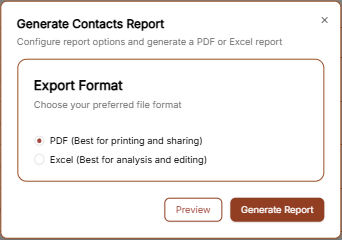
To export your contact data for external use, click the Generate Report link located next to the add contact button.
-
Choose Export Format: A window will appear allowing you to select your preferred file format.
-
PDF: Best for printing and sharing official documents.
-
Excel: Best for deep data analysis and bulk editing.
-
-
Preview or Generate: You can choose to Preview the report first or click Generate Report to immediately create the file.
Goldilocks CRM Deals
Goldilocks CRM Deals Dashboard
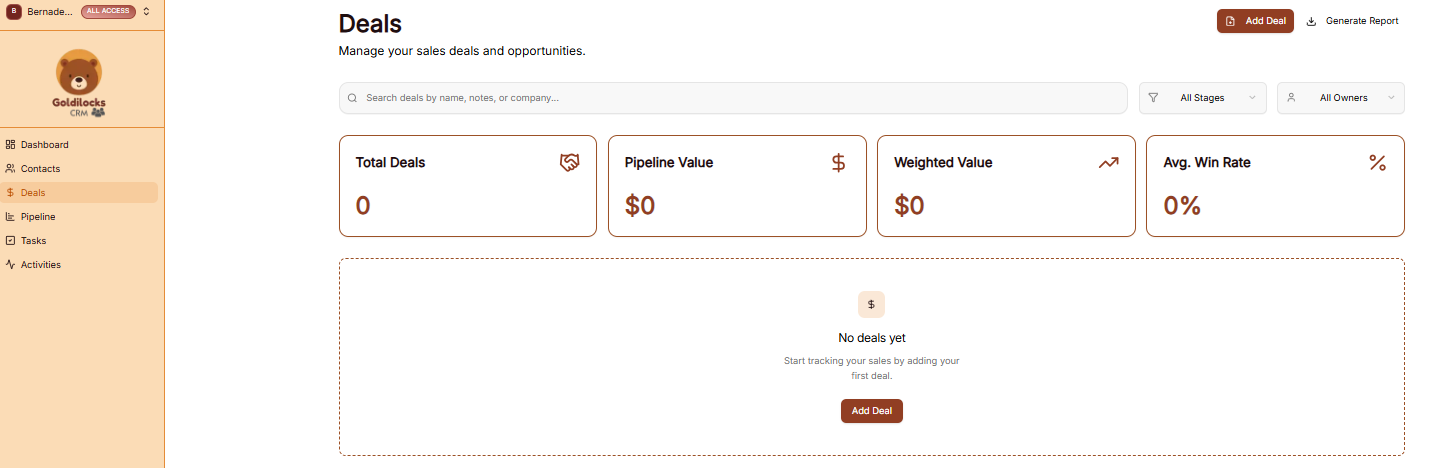
The Deals module is where you track revenue opportunities and their progress through your sales cycle. The dashboard provides four high-level metrics to monitor your sales health:
-
Total Deals: The total number of opportunities currently in your system.
-
Pipeline Value: The combined financial value of all active deals.
-
Avg Deal Size: The average value of your open opportunities.
-
Win Rate: The percentage of deals successfully closed.
How to Add a Deal
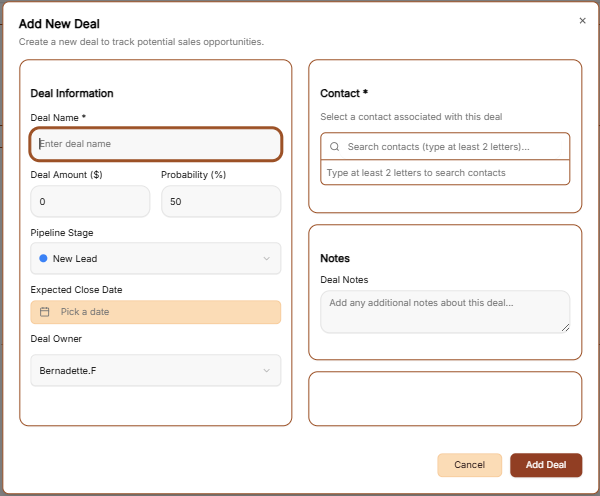
To record a new sales opportunity, click the brown + Add Deal button at the top right of the screen. This opens a form with the following fields:
-
Basic Information: Enter the Deal Name and the expected Amount.
-
Customer & Timeline: Select the associated Customer from your contacts and set an estimated Close Date.
-
Pipeline Placement: Assign the deal to a specific Pipeline and Stage (e.g., New Lead, Discovery, Proposal).
-
Ownership & Priority: Designate a Deal Owner and set a Priority level (Low, Medium, or High).
-
Tags & Notes: Categorize the deal with Tags and include any background context in the Notes section.
-
Finalize: Click the brown Add Deal button to save the record.
Generate Report
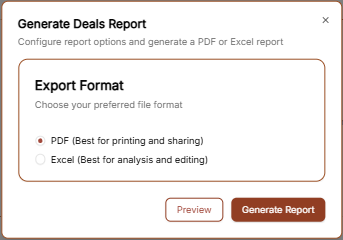
You can export your deal data by clicking the Generate Report link in the top right corner.
-
Export Format: Choose your preferred file type.
-
PDF: Best for sharing a visual summary of your sales performance.
-
Excel: Best for calculating commissions and detailed revenue forecasting.
-
-
Action: Select Preview to review the data or Generate Report to download the file immediately.
Goldilocks CRM: Sales Pipeline
Goldilocks CRM: Sales Pipeline
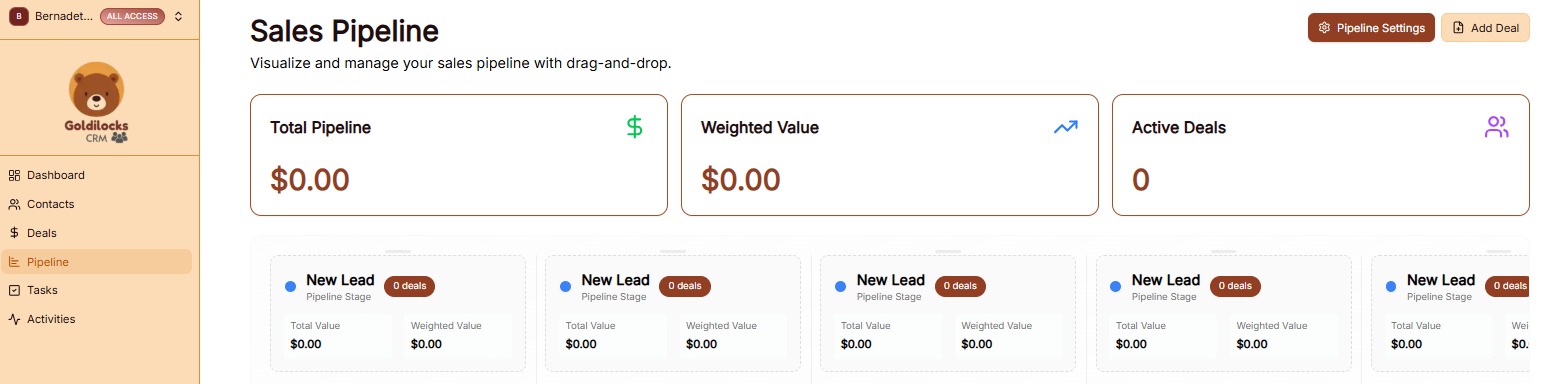
Pipeline Dashboard
The Pipeline page allows you to visualize and manage your sales flow with drag-and-drop. This board provides a real-time overview of your business health through high-level metrics:
-
Total Pipeline: Displays the total financial value of all deals currently in the board.
-
Weighted Value: Shows the adjusted value of your pipeline based on the probability of deals closing.
-
Active Deals: The total count of open opportunities currently being tracked.
Customizing Your Pipeline
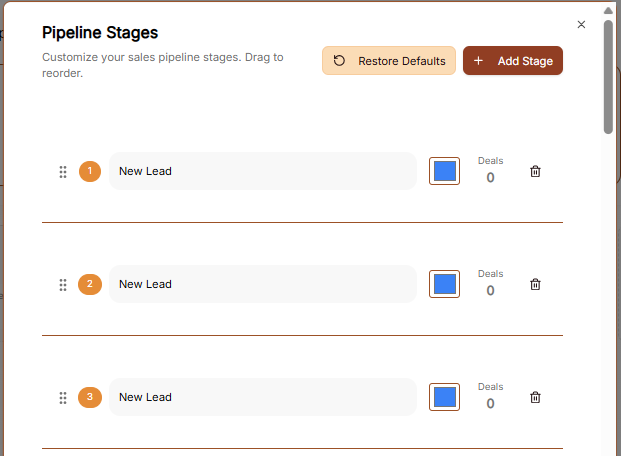
To modify how your sales process is organized, use the Pipeline Settings link located at the top of the board.
Managing Pipeline Stages:
-
Pipeline Settings: Click this link to access the customization area where you can add or change the stages of your sales cycle.
-
Customize Stages: Within the settings, you can adjust your pipeline to fit your specific business needs, such as renaming columns or reordering your workflow.
-
Stage Columns: By default, your deals are organized into stages including New Lead, Discovery, Proposal, and Negotiation.
-
Stage Totals: Each stage header shows the number of deals in that specific phase and their combined value.
Managing Deals
-
Add Deal: Click the brown + Add Deal button at the top right of the dashboard to immediately create a new opportunity within the selected pipeline.
-
Deal Tracking: Individual cards on the board show the Deal Name, Customer, and the Total Amount for quick reference.
Goldilocks CRM: Tasks
Goldilocks CRM: Tasks
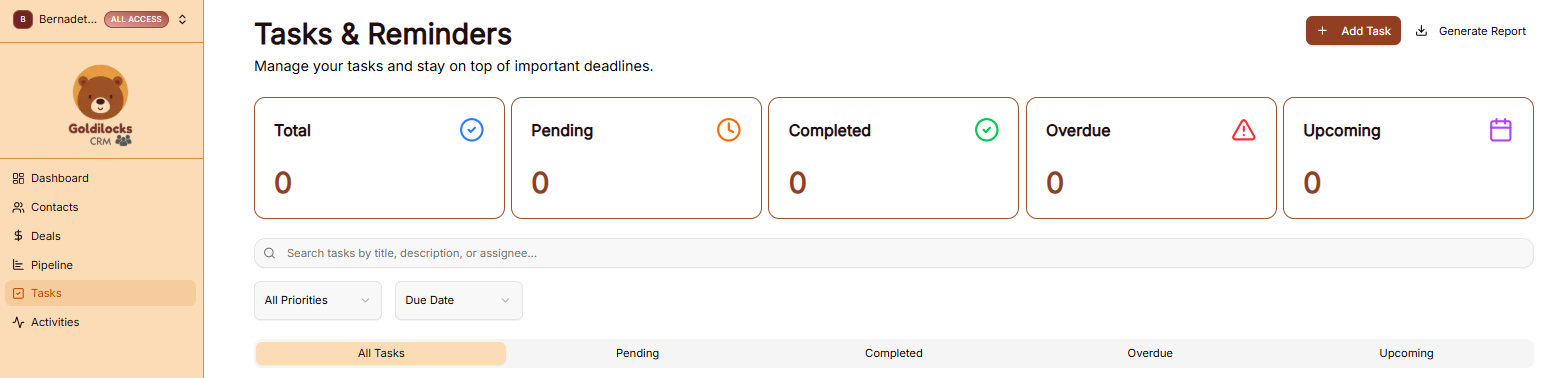
The Tasks module allows you to manage your daily to-do lists and stay on top of important project deadlines.
Tasks Dashboard Overview
The main dashboard provides a high-level summary of your current workload through five key metric cards:
-
Total: The overall count of all tasks assigned to you.
-
Pending: Tasks that are currently open and awaiting action.
-
Completed: A count of all finalized tasks.
-
Overdue: Tasks that have passed their assigned due date without being completed.
-
Upcoming: A look-ahead at tasks scheduled for the near future.
Managing Your Task List
You can organize and find specific tasks using the following tools:
-
Search Bar: Locate tasks quickly by searching for their title, description, or the assigned team member.
-
Filtering: Narrow your view by using the All Priorities or Due Date dropdown menus.
-
Quick View Tabs: Switch between status-specific lists, including All Tasks, Pending, Completed, Overdue, and Upcoming.
Adding a New Task
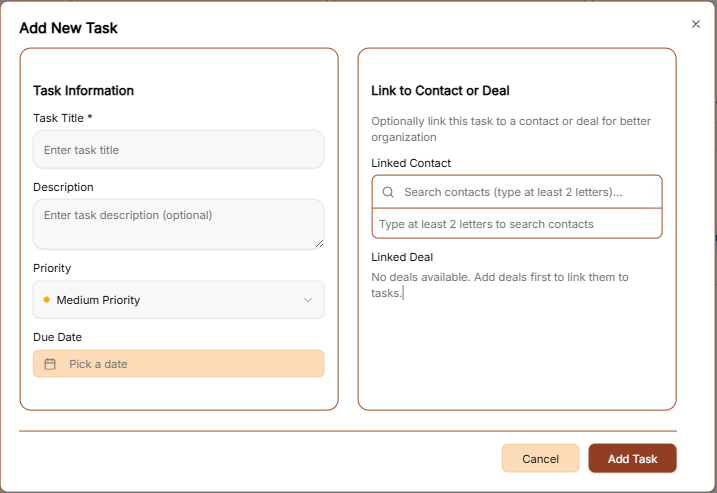
To create a new entry, click the brown + Add Task button at the top right of the screen. This opens the Add New Task window:
Task Information:
-
Task Title: Enter a clear, concise name for the task.
-
Description: Add optional details or specific instructions for the task.
-
Priority: Use the dropdown to set the importance level (e.g., Medium Priority).
-
Due Date: Click the calendar icon to pick a specific deadline.
Connections & Finalization:
-
Link to Contact or Deal: Optionally link the task to a specific person or sales opportunity for better organization.
-
Save: Click the brown Add Task button at the bottom right to save the task to your list.
Generating a Tasks Report
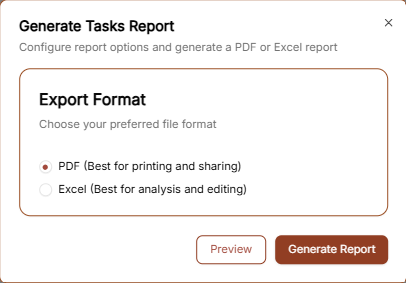
To export your current task data, click the Generate Report link in the top right corner.
-
Choose Format: Select either PDF (best for printing/sharing) or Excel (best for data analysis).
-
Finalize: Click Preview to check the layout or Generate Report to download the file.
Goldilocks CRM: Activities
Goldilocks CRM: Activities
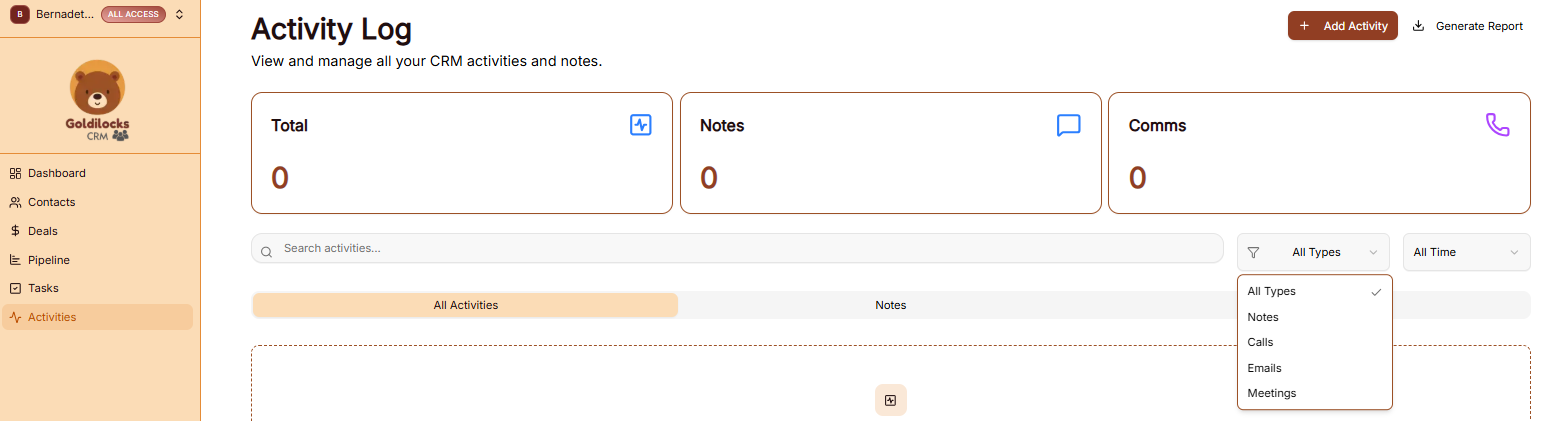
The Activities module provides a chronological log of every interaction and system update within your workspace, ensuring you have a complete history of your engagement with contacts and deals.
Activities Dashboard Overview
The main dashboard helps you track the volume and type of interactions across your team:
-
Total Activities: The overall count of all logged interactions.
-
Calls: Specifically tracks the number of phone interactions recorded.
-
Notes: Displays the count of text-based updates or internal memos saved.
-
Emails: Tracks the number of email communications logged in the system.
-
Meetings: Shows the total number of scheduled or completed appointments.
Managing the Activity Log
Use the following tools to organize your history and find specific records:
-
Search Bar: Quickly find specific interactions by searching for keywords within the notes or activity titles.
-
Filtering: Use the All Types and All Owners dropdown menus to narrow the log down to specific interaction categories or team members.
-
Activity List: Each entry in the list displays the interaction type (e.g., Call), a brief summary (e.g., "Follow up on GoldilocksCRM activities import"), and a timestamp of when it occurred.
How to Add an Activity
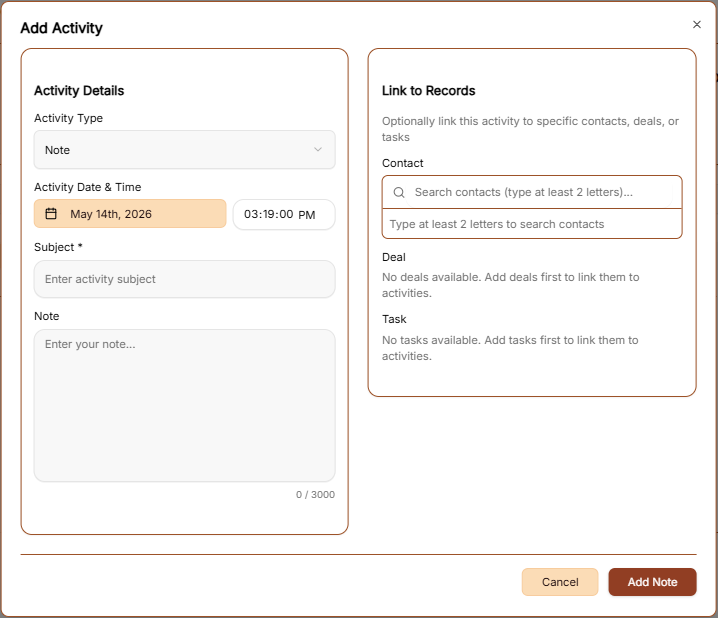
To manually record a new interaction, click the brown + Add Activity button at the top right. This opens a configuration window:
-
Activity Title: Enter a brief name for the interaction.
-
Activity Type: Use the dropdown to categorize the entry (e.g., Call, Meeting, Email, or Note).
-
Date & Time: Set the exact timing of when the activity took place.
-
Notes: Add detailed context or specific outcomes from the interaction.
-
Connections: Link the activity to a specific Contact or Deal to ensure it appears in their respective histories.
-
Add Activity: Click the brown button at the bottom right to save the record.
Generate Report
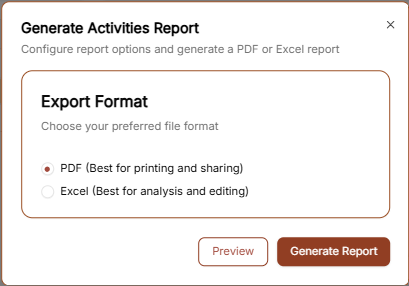
To export your interaction history, click the Generate Report link in the top right corner.
-
Export Format: Select between PDF for a clean visual log or Excel for detailed data review.
-
Action: Choose Preview to see the layout or Generate Report to download the final file.
User Profile & Settings
User Profile & Settings

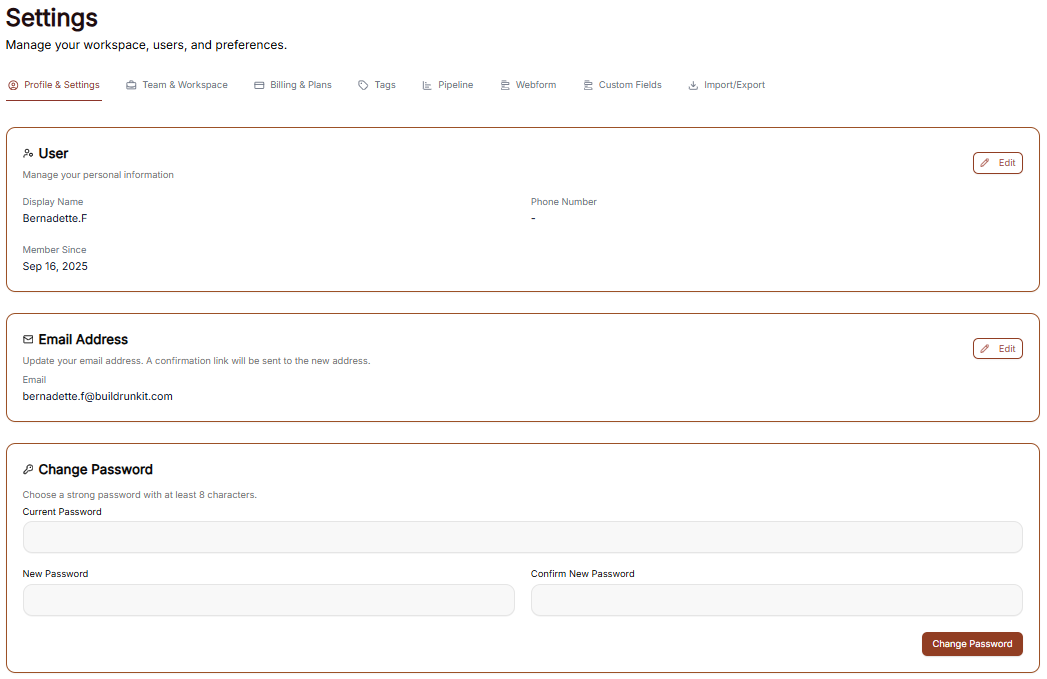
The Settings area allows you to manage your personal information, account security, and how the interface appears to you.
Managing Personal Information
Under the User Settings tab, you can view and update your primary account details:
-
Profile Details: This section allows you to manage your identity. You can enter and update your First Name, Last Name, Email, and Phone number in the provided text fields.
-
Bio: Use the larger text area to add a brief professional summary or description to your profile.
-
Save Changes: Click the brown Save Changes button at the bottom right to finalize any updates to your personal information.
Account Security
You can manage your account access and protection through the Security menu:
-
Password Management: Update your login credentials to keep your account secure.
-
Notifications: Configure how and when you receive system alerts and updates.
Interface Preferences
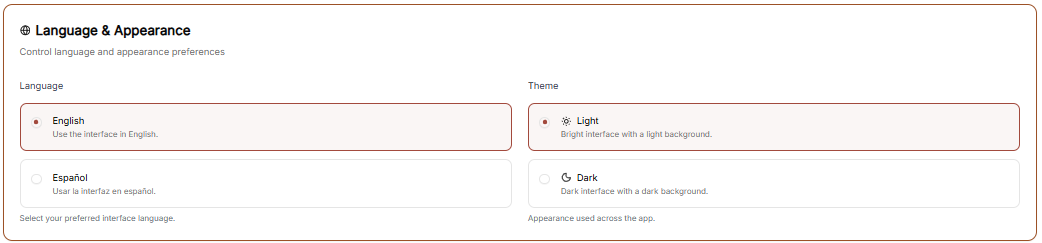
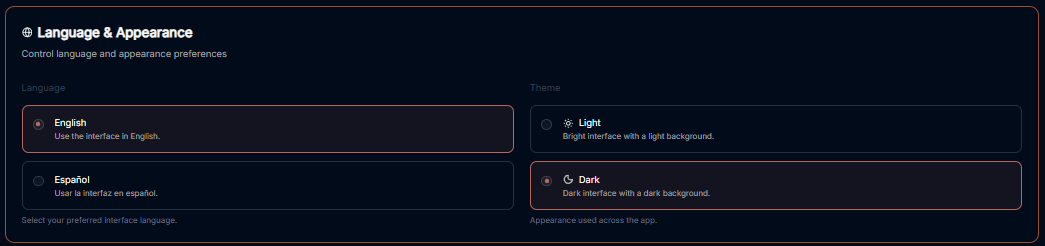
You can customize the look of your workspace through the Appearance menu to match your working environment.
Theme Selection Adjust the visual style of the application:
-
Light: A bright interface with a light-colored background.
-
Dark: A high-contrast interface with a dark background, ideal for low-light environments.
-
System: Automatically syncs the interface theme with your device's operating system settings.
-
Update Theme: Click the brown Update Theme button to apply your chosen visual style.
Workspace Management
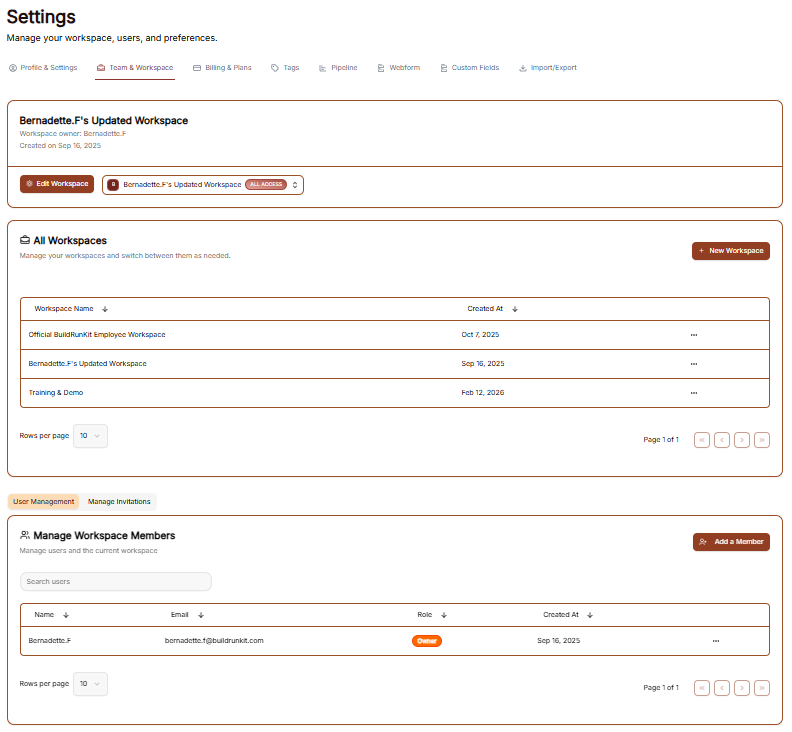
The Workspace settings allow you to control the environments you belong to, manage your team, and update workspace identities.
All Workspaces
This tab provides an overview of every workspace your account is currently associated with.
-
Status & Plans: You can see the name of each workspace and its current subscription plan (e.g., "Custom" or "Enterprise").
-
Leaving a Workspace: By clicking the three dots (actions menu) next to a workspace, you can select Exit to remove yourself from that environment.
Edit Workspace
This is where you manage the primary identity of your current business environment.
-
Changing the Name: Use the Edit Workspace section to update the display name of the workspace.
-
Save Changes: Ensure you click the brown Save Changes button after renaming to apply the update across the suite.
Manage Workspace Members
Control who has access to your workspace in this section.
-
Member List: View all users, their email addresses, and their assigned roles (e.g., Owner).
-
Invite Members: Click the + Invite member button at the top right to add a new person to the team via email.
-
Removing Users: To revoke access, click the three dots (actions menu) next to a member's name and select Remove user.
Subscription & Billing
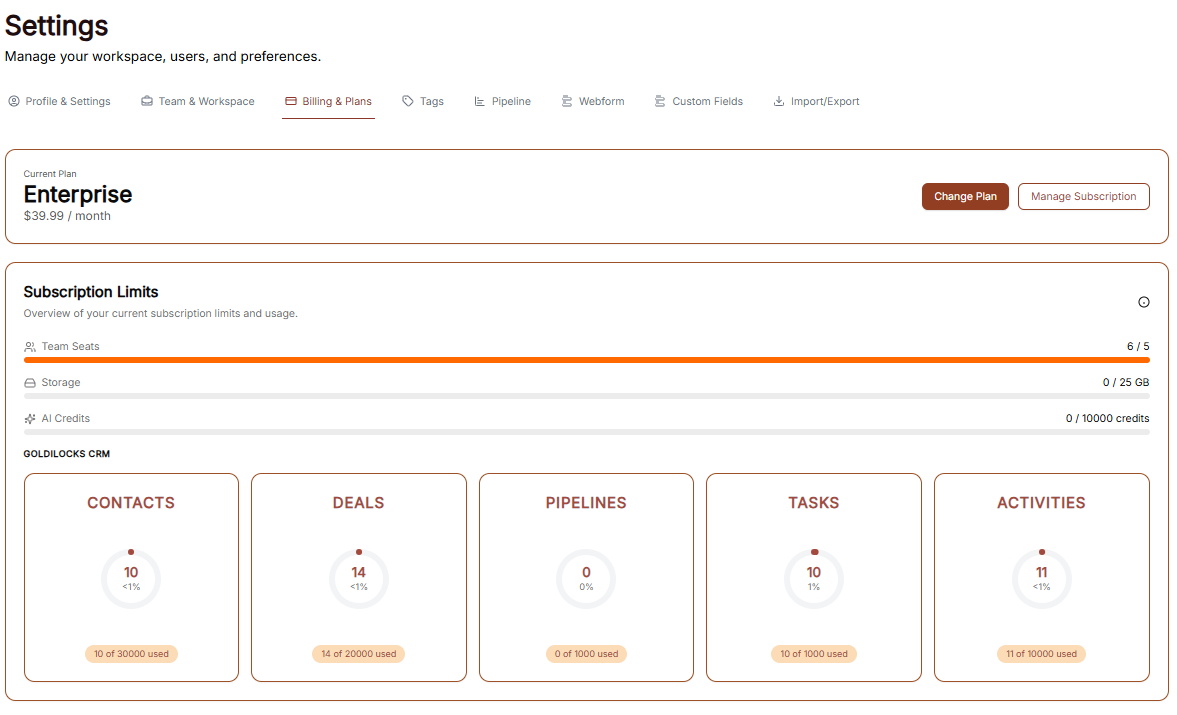
The Subscription area is your hub for managing plan access, tracking workspace limits, and handling payments.
Subscription Overview
This tab provides a high-level view of your current standing:
-
Active Plan: Displays the name of your current plan (e.g., "Custom").
-
Cost Details: Shows the recurring price and billing frequency (e.g., "$0.00 / Monthly").
-
Usage Trackers: Three progress bars track your real-time usage for Invoices, Customers, and Items against your plan’s total capacity.
-
Management Buttons: * Change Plan: Opens the tier selection menu.
-
Cancel Subscription: Initiates the process to stop recurring payments.
-
Changing Your Plan
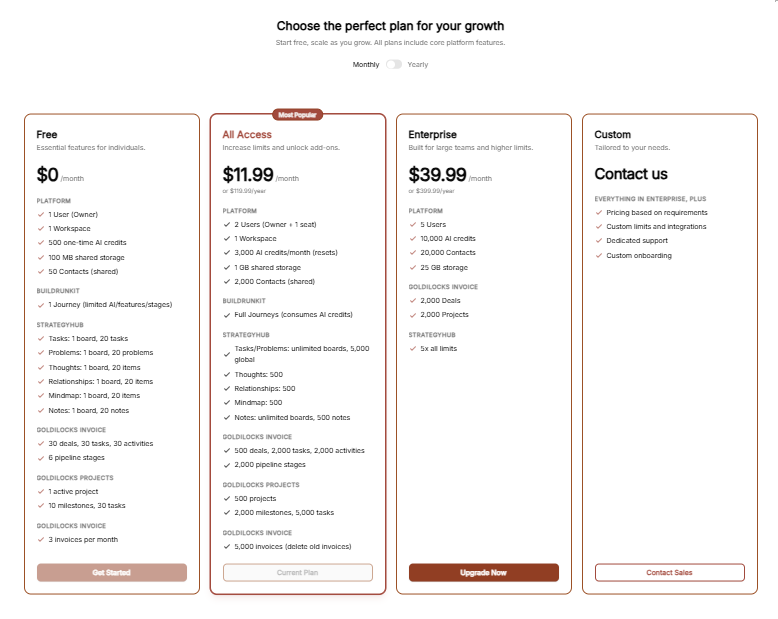
Clicking Change Plan reveals the available subscription tiers:
-
Billing Toggle: A switch at the top to toggle between Monthly and Yearly pricing.
-
Plan Tiers: Choose between Free, Plus, and Pro.
-
Tier Limits: Each column details the specific limits for Invoices, Customers, Items, and Workspace Members.
-
Action: Click the brown Choose Plan button under your desired tier to proceed.
Add-ons
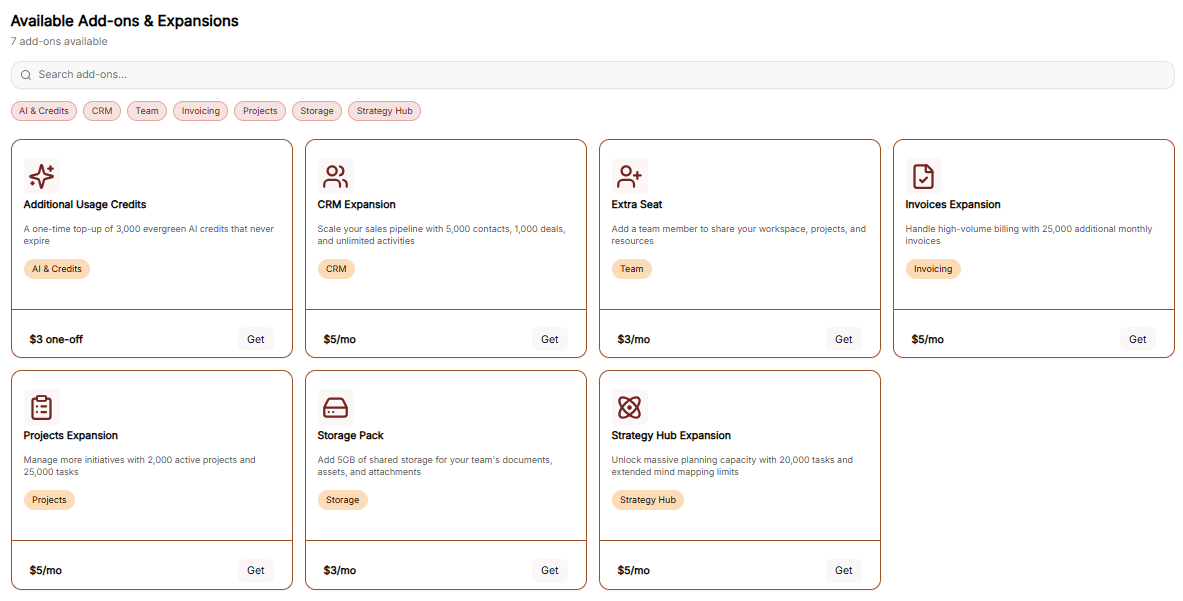
The Add-ons tab allows for modular upgrades without changing your full plan:
-
Available Features: You can purchase extra Invoices, Customers, Items, or Workspace Members.
-
Pricing: Each add-on lists its specific monthly cost.
-
Action: Click the brown Buy button next to the relevant feature to initiate the purchase.
Checkout Process
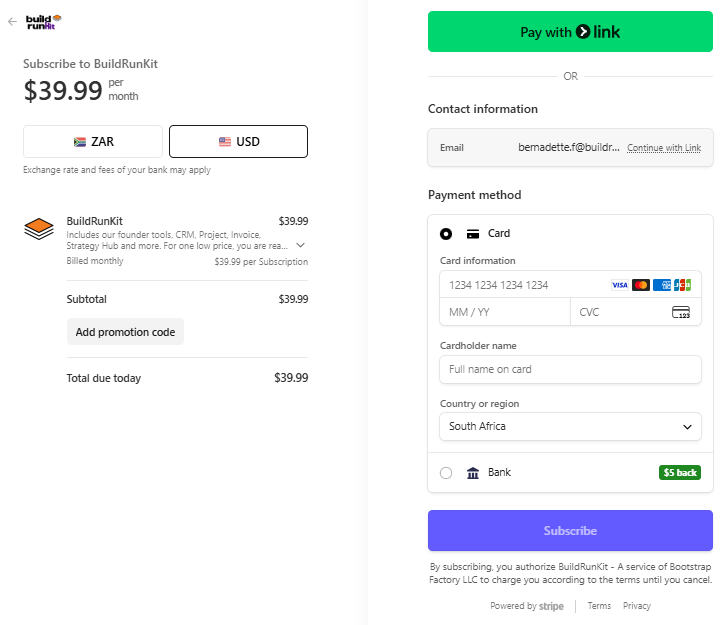
The Checkout page is the final step for any plan change or add-on purchase:
-
Back to subscription: A link at the top left to return without purchasing.
-
Payment Method: Confirms the card on file that will be charged for the transaction.
-
Order Summary: Displays the Subtotal, Tax, and the final Total Amount Due.
-
Action: Click the brown Pay & Subscribe button to finalize the order and update your workspace limits.
Tags Settings
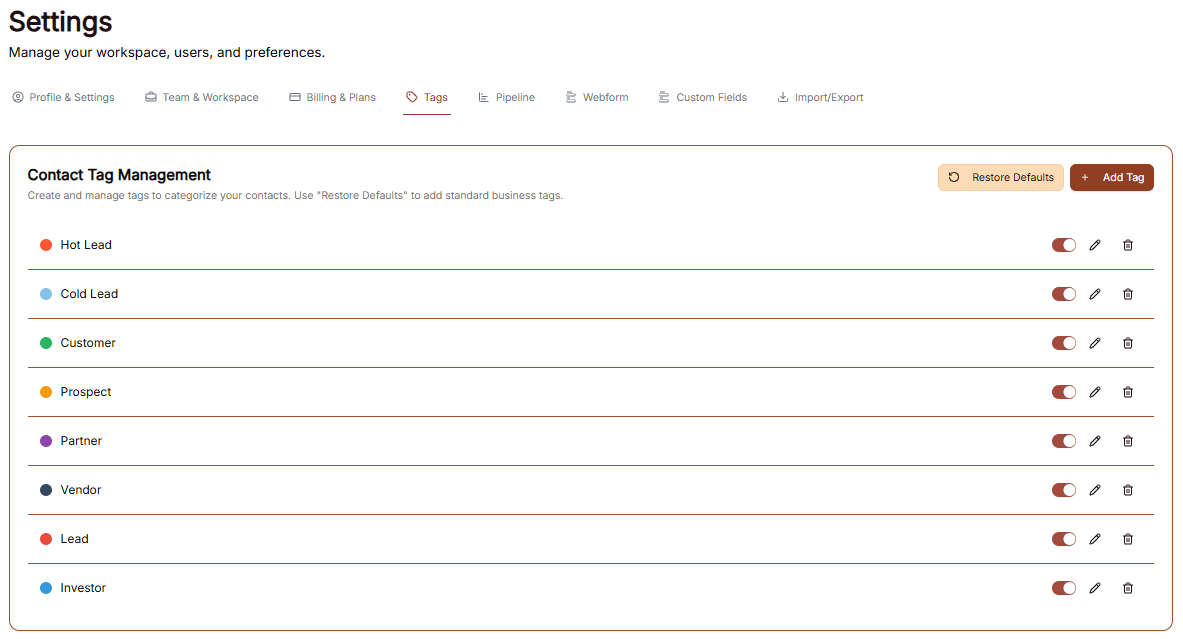
The Settings area includes a dedicated section for managing your contact categorization through the Tags menu. This allows you to label and organize your contacts based on their relationship to your business.
Contact Tag Management
Customizing Your Tags
You can further tailor your labeling system using the management buttons at the top right of the list:
-
Add Tag: Click the brown + Add Tag button to create a brand-new category specific to your workflow.
-
Restore Defaults: Use this button to automatically add a standard set of business tags to your workspace if you need a quick starting point.
Pipeline Settings
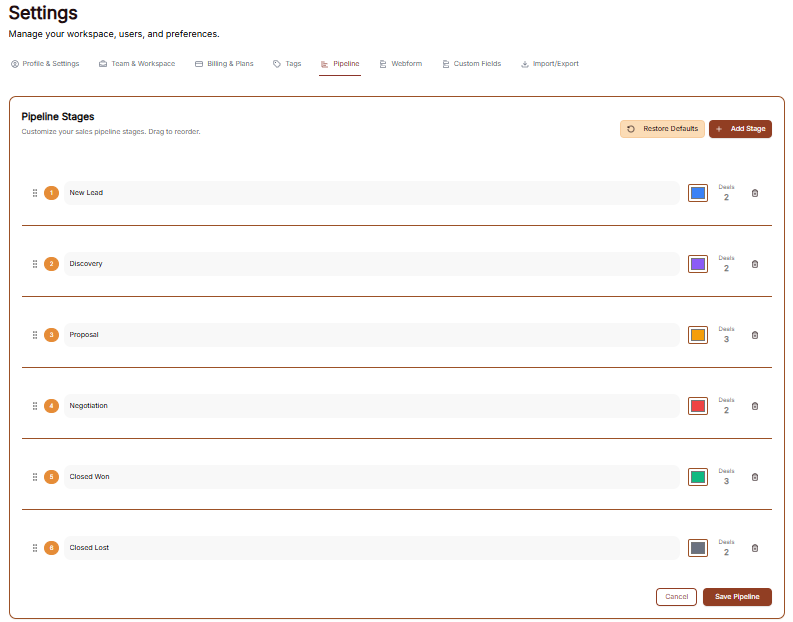
The Pipeline section in Settings allows you to customize the stages of your sales process to match your specific workflow.
Managing Pipeline Stages
In the Pipeline Stages tab, you can define the progression of your deals from initial contact to completion:
-
Current Stages: View your active pipeline stages, such as New Lead, Discovery, Proposal, Negotiation, Closed Won, and Closed Lost.
-
Reorder Stages: Use the drag-and-drop handle (six dots) on the left of each stage to change the order of your sales process.
-
Stage Colors: Each stage is associated with a specific color for easy visual identification in the main Pipeline view.
-
Deal Count: Monitor how many active deals are currently assigned to each specific stage.
-
Delete Stage: Click the trash can icon to remove a stage that is no longer needed in your process.
Customizing Your Workflow
You can modify the structure of your sales pipeline using the primary management tools:
-
Add Stage: Click the brown + Add Stage button at the top right to create a new step in your sales cycle.
-
Restore Defaults: Use this button to reset your pipeline to a standard set of business stages.
-
Save Pipeline: Once you have finished making adjustments, click the brown Save Pipeline button at the bottom right to apply your changes.
Webform
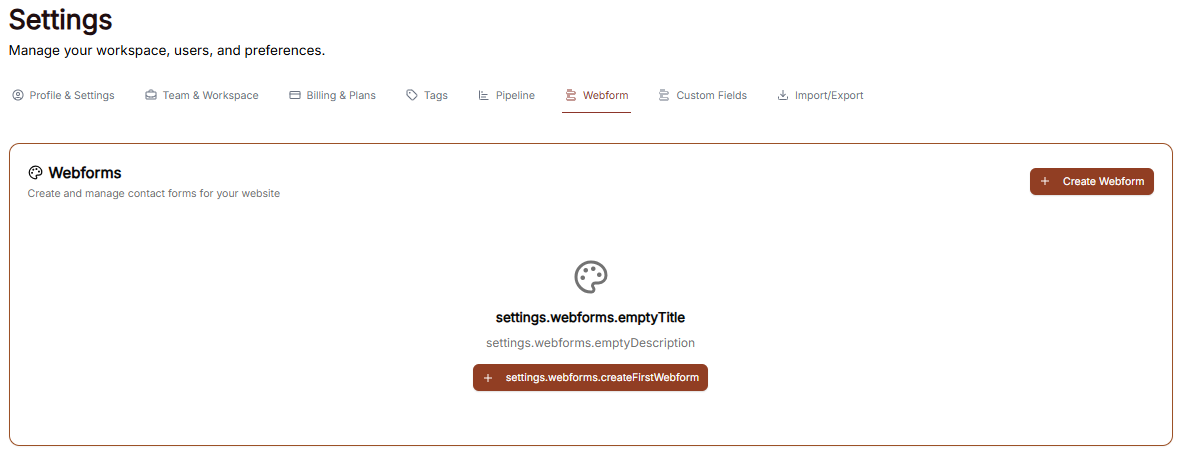
The Webform section in Settings allows you to create and manage custom contact forms to embed on your website, streamlining how you capture new leads.
Managing Webforms
In the main Webforms tab, you can oversee your collection of active forms:
-
Create Webform: Click the brown + Create Webform button to start building a new form.
-
Form List: View all existing forms and their current status within your workspace.
Creating a New Webform
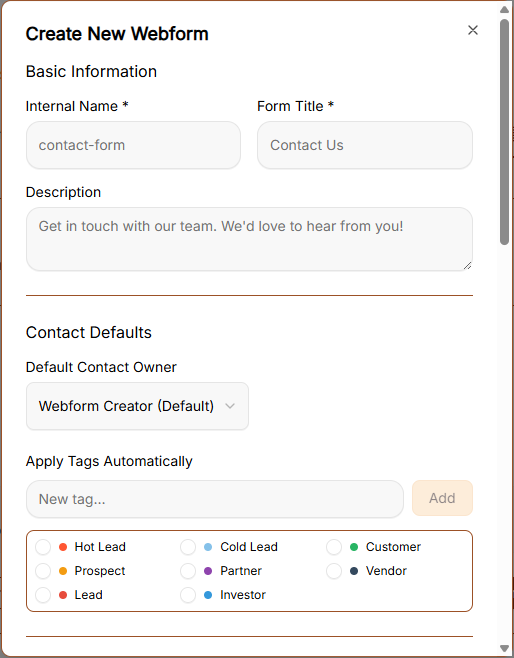
When building a form, you can customize the information gathered, automate contact settings, and define the visual style to match your brand:
Basic Information
-
Internal Name: Input a unique identifier for internal tracking (e.g., "contact-form").
-
Form Title: Define the public-facing title displayed at the top of your form (e.g., "Contact Us").
-
Description: Provide a brief public message or instructions for your visitors (e.g., "Get in touch with our team. We'd love to hear from you!").
Contact Defaults & Automation
-
Default Contact Owner (Auto-Assignment): Use the dropdown menu to assign a default team member responsible for new leads generated through this form.
-
System Behavior: New submissions are routed automatically to this person. If an existing contact submits the form, their current owner remains unchanged to prevent workflow disruptions.
-
-
Apply Tags Automatically (Auto-Tagging): Select tags to apply automatically to contacts upon submission. Options include Hot Lead, Cold Lead, Customer, Prospect, Partner, Vendor, Lead, Investor, and VIP.
-
System Behavior: If the contact already exists in your database, these new tags are appended without deleting any of their existing tags.
-
Form Fields
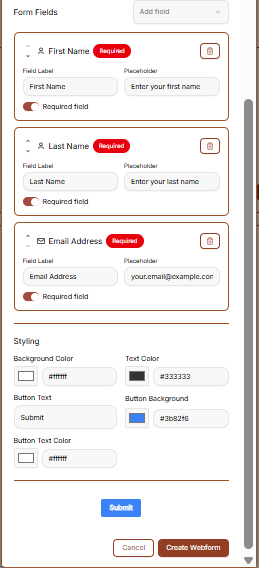
-
Field Addition: Use the Add field dropdown menu at the top right of the section to introduce new data points.
-
Standard Fields: Arrange and configure core contact fields, including First Name, Last Name, and Email Address.
-
Field Labels & Placeholders: Customize the visible label text and the temporary placeholder hint inside the box (e.g., "your.email@example.com").
-
Requirements: Toggle the Required field switch to determine if a field must be completed before submission. Mandatory fields display a red Required badge.
-
Removal: Click the trash can icon on any field block to delete it from the form layout.
Styling & Submission Details
-
Background Color: Define the primary block color using hex codes (e.g., #ffffff).
-
Text Color: Set the visual hex code for standard form labeling (e.g., #333333).
-
Button Text: Customize the text displayed inside the submission button (e.g., "Submit").
-
Button Background: Select a hex code to brand the main button element (e.g., #3b82f6).
-
Button Text Color: Specify the hex value for the text inside the submission button (e.g., #ffffff) to ensure proper visual contrast.
-
Live Preview: Review the interactive button component at the bottom of the panel to verify color combinations before deploying.
Finalizing Your Form
-
-
Cancel: Click Cancel to discard changes and close the form builder.
-
Create Webform: Click the brown Create Webform button to save your settings and activate the form.
-
Custom Fields
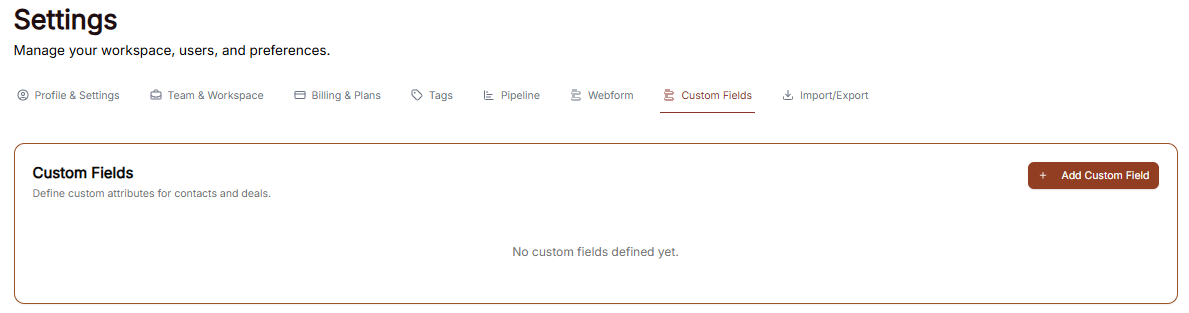
The Custom Fields section in Settings allows you to define unique attributes for your records, ensuring you can capture specific data points that are important to your business but not included in the standard fields.
Managing Custom Fields
In the main Custom Fields tab, you can oversee all specialized data points you have created for your workspace:
-
Add Custom Field: Click the brown + Add Custom Field button at the top right to define a new attribute.
-
Field Overview: This area displays a list of all current custom fields. If none have been created yet, the screen will show a "No custom fields defined yet" message.
Adding a Custom Field
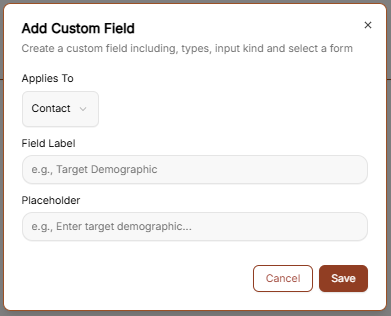
When you create a new field, you can specify exactly how it functions and where it appears:
-
Applies To: Use the dropdown menu to select whether the new field should be attached to a Contact or a Deal.
-
Field Label: Enter the name of the field as you want it to appear in the interface (e.g., "Target Demographic").
-
Placeholder: Customize the hint text that appears inside the input box to guide data entry (e.g., "e.g., Enter target demographic...").
-
Save: Click the brown Save button to finalize the field and add it to your records.
Import & Export
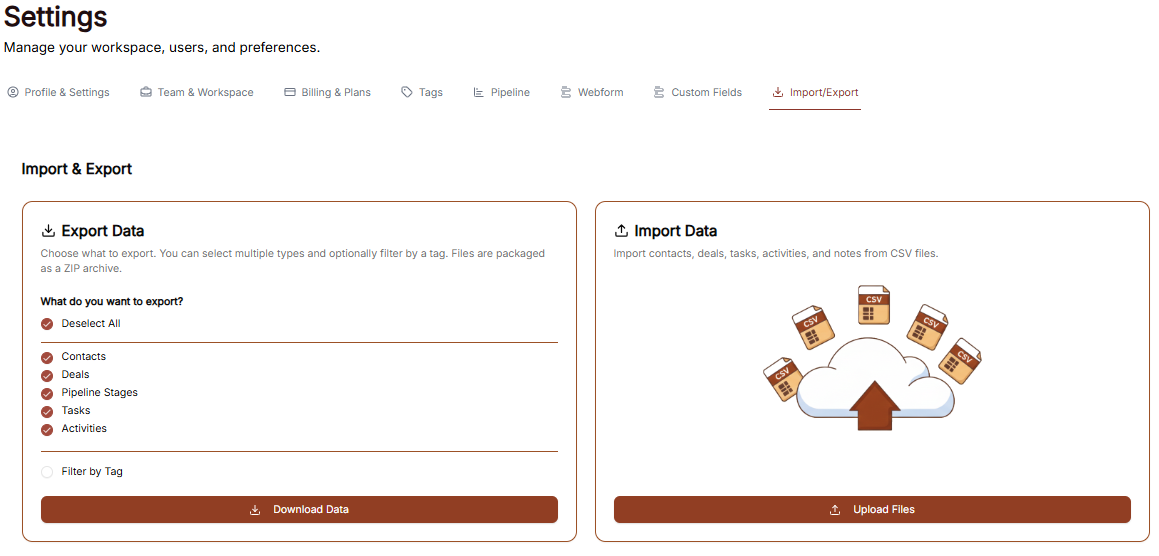
The Import/Export section allows you to migrate data into your workspace or download your current records for external use.
Data Import Process

To ensure your data is formatted correctly before uploading, you can use the built-in templates provided by the CRM:
-
Step 1: Download Templates: Before you begin your upload, use the Download Template links for Contacts, Deals, or Tasks. These files contain the correct column headers to make mapping seamless.
-
Step 2: Upload File: Once your template is filled out, select the appropriate category and upload your file.
-
Step 3: Map Fields: Align your spreadsheet columns with the CRM fields.
-
Step 4: Preview & Finish: Review your data sample, then complete the import to add the records to your workspace.
Importing Tasks
When you reach the Tasks portion of the tool, you have two final choices:
-
Upload Tasks: If you have task data ready in the template, click this button to process it.
-
Finish and go to Dashboard: Click this to exit the setup and return to your main dashboard.
Data Export
The export tool allows you to create portable backups of your information:
-
Select Records: Choose to export your Contacts, Deals, or Tasks.
-
Export Action: Click the brown Export Data button.
-
File Format: Your records will automatically download as a ZIP file. You must extract this folder on your computer to access the individual spreadsheet files inside.
Feedback and help
Feedback and help

This section allows you to communicate with the team and access support resources directly within the platform.
Sidebar Menu
-
Feedback: The primary link to open the feedback submission window.
-
Help: The link located directly underneath "Feedback" for support resources.
Feedback
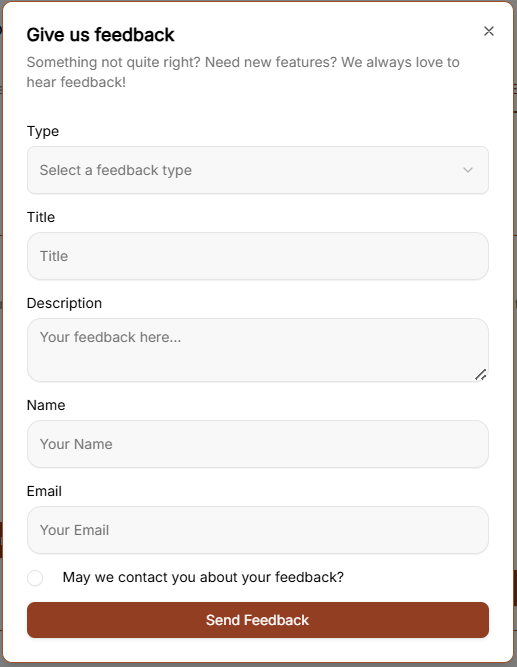
Clicking Feedback opens a window with the following fields:
-
Category: A dropdown menu to select the nature of your message. The options include:
-
Bug Report
-
Feature Request
-
General Feedback
-
Question
-
-
Subject: A text input field to summarize your feedback.
-
Message: A large text area for providing the full details of your report or suggestion.
-
Send Feedback: The brown button at the bottom of the form used to submit your information.
Help
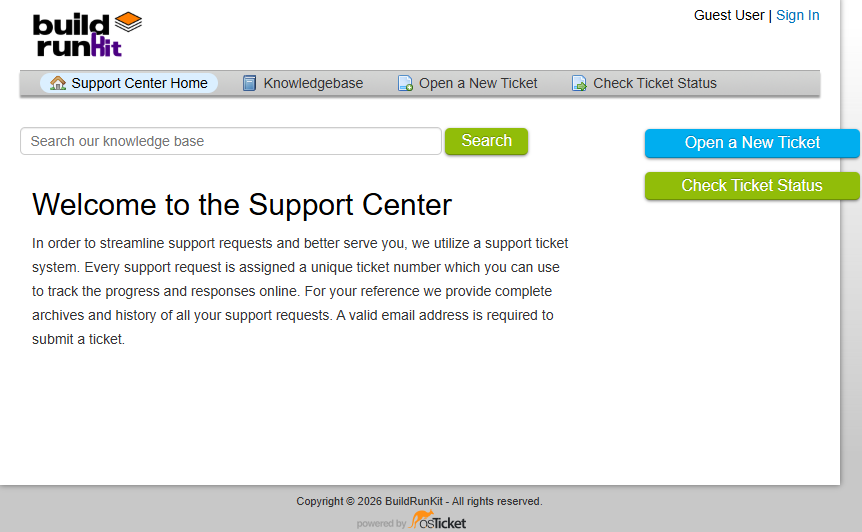
To access the support portal, click the Help option located at the bottom of the navigation sidebar. This opens the Support Center in a new window.
Support Center Home
The main landing page of the Support Center provides a centralized location for managing support requests:
-
Search: A search bar is located at the top to search the knowledge base for specific information.
-
Support Ticket System: The platform uses a ticket system where every request is assigned a unique number to track progress online.
-
Email Requirement: A valid email address is required to submit a new ticket.
Navigation Menu
-
Support Center Home: Returns you to the main welcome page.
-
Knowledgebase: Provides access to categorized FAQs and documentation.
-
Open a New Ticket: Opens a form to submit a direct support request.
-
Check Ticket Status: Allows you to view the progress of existing tickets using your email and ticket number.
Knowledgebase
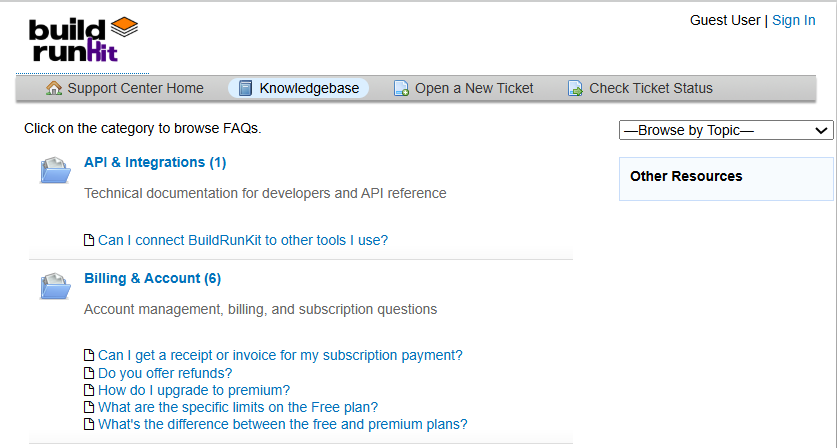
The Knowledgebase tab allows you to browse support articles by category to find answers to common questions.
-
Browse by Topic: Use the dropdown menu on the right to jump directly to a specific help topic.
Open a New Ticket
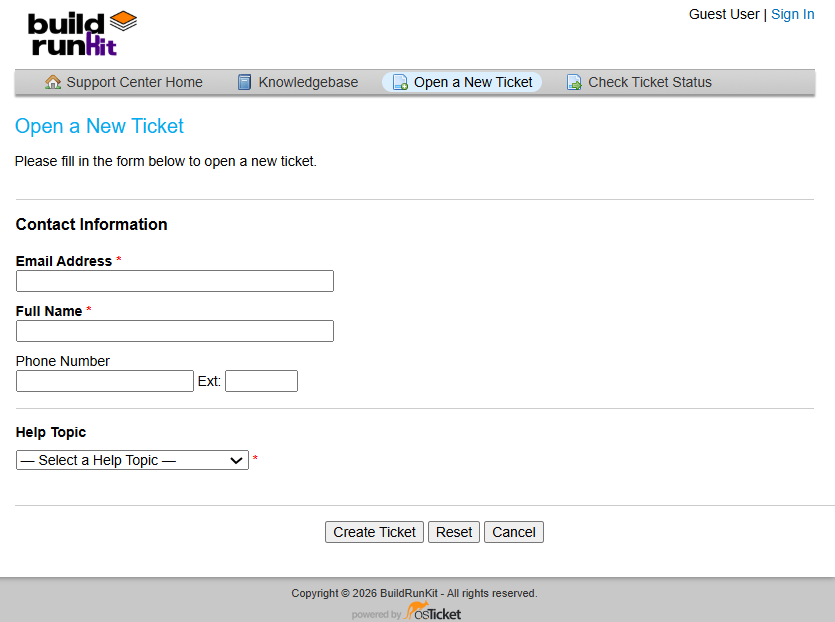
This section allows you to submit a formal support request to the team.
Contact Information
-
Email Address *: A required field to enter your contact email.
-
Full Name *: A required field to provide your name.
-
Phone Number: An optional field with a separate box for an Ext: (extension).
Ticket Details
-
Help Topic *: A required dropdown menu where you must "-Select a Help Topic -" to categorize your request.
Form Actions
-
Create Ticket: Click this button to submit your request.
-
Reset: Click this button to clear all information currently entered in the form.
-
Cancel: Click this button to exit the ticket creation process.
Check Ticket Status
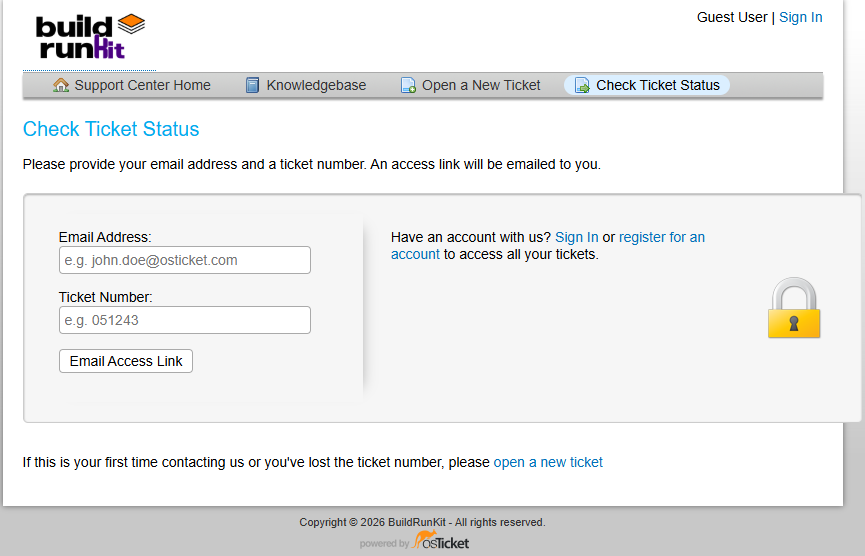
This section allows you to track the progress of your existing support requests.
Check Status via Email To access a specific ticket, provide the following details to receive an access link via email:
-
Email Address: Enter the email address associated with your ticket (e.g., john.doe@osticket.com).
-
Ticket Number: Enter the unique ID assigned to your request (e.g., 051243).
-
Email Access Link Button: Click this to have the login link sent to your inbox.
Account Access
-
Sign In / Register: If you have an account, you can Sign In or register for an account to view a complete history of all your tickets in one place.
-
Security: This form is protected, indicated by the padlock icon on the right.
Troubleshooting
-
First-time contact: If you have never contacted support before or have lost your ticket number, click the open a new ticket link at the bottom of the page.